Dunrovin Ranch

THE Destination Ranch of Western Montana

  • About
    • Getting Here
    • The Bitterroot Valley
    • The Dunrovin Difference
    • Our Staff
      • The Miller Family
    • Our Animals
  • Activities
  • Contact/Payment
  • Webcam

Dec 21 2014

Meet the Guests: Shigeko Sasamori

Sasmori with Steve-Teal

Surviving

Written by Danielle Lattuga

The simple act of running one’s fingers through one’s hair rarely prompts a person to reflect on their purpose in life. It’s not about being an insensitive person, but more about the relatively unconscious acts that accompany us, as we tackle seemingly “larger” and more challenging tasks. Even if we are new to horseback riding, we are less likely to think about how a reign feels in our fingers and more about how we are going to stay on the horse. But, we notice the blue sky and that beauty is reflected in the expression of our faces when we comment on it to our friends, co-workers, or even strangers.

Shigeko Sasamori was 13 years old when she went to work as a student cleaning and “fire-scaping” the streets in Hiroshima City, Japan. She remembers the beautiful blue sky, on her first morning, and the shining silver plane flying overhead. Then there were “white things coming down” and a tremendous pressure that knocked her to the ground.

She came to, in pitch black and silence, “It was just like a dead city,” she has said.

She’d survived the atomic bombing of Hiroshima, by the sheer luck of the draw. Her mother had given her a new pair of pants to wear for work, and she was wearing them under her old pair, to protect them. The pants ended up protecting her, by providing enough layers to prevent her legs from being severely burned by the heat ray of the bomb. All around her, there were people with no clothing, just skin hanging off, and their hair had been burned to ash.

“I’ve never been to hell, but if there is a hell, (it is) probably like that.”

Slowly, her senses returned to her, and she heard a baby crying, and felt pain and euphoria, intermittently, as her body went through the shock. For five days in the searing hot summer of Japan, she survived with no food and water, speaking her name and address over and over, and asking for  water, whenever someone was near. Finally, someone heard her, went to the vicinity of her home, and helped to reunite her with her parents. They repeatedly rubbed her burned body with cooking oil, and she survived.

Ten years later, she was chosen as one of 25 “Hiroshima Maidens,” who were brought to the United States for reconstructive surgery. Because her legs had not been burned, she had healthy skin to use for skin grafts on her upper body and face.

Shigeko does not show expression in her face the way most people do, and her hands were damaged enough that she has limited mobility in her fingers. Yet, she is able to convey the power of singular moments with great emotion and clarity. She describes the world on very sensual terms and in a vivacious manner, even when she is narrating the tragedy that defined so much of her life and that of others around her.

Shigeko Sasamori visited Montana in August of 2008. She was part of a group of atomic bomb survivors touring the United States with Steven Leeper, the first non-Japanese head of the Hiroshima Peace Culture Foundation. The foundation administers a museum that explains the consequences and horrors of atomic and nuclear weapons. Leeper also lobbies for an international ban on all nukes called the Hiroshima-Hiroshima Protocol. Sasamori serves as the C.E.O. of the Hiroshima and Nagasaki Peace Projects, L.L.C. She gave a talk to a capacity crowd at the University of Montana Student Center.

Then, she went for a horseback ride. Leeper and his wife Elizabeth were staying with his brother and sister-in-law, Sterling and SuzAnne Miller, during the group’s visit to Missoula. When Shigeko got wind of the fact that they were staying at Dunrovin Equestrian Ranch, she told Steve that she had always wanted to ride a horse. She was 78 at the time.

Miller willingly saddled up her pony, Cool Dude, because his size and demeanor would best suit an elderly petite woman, who wouldn’t be able to grasp the reigns very well. Then she gently walked the pony around the ring. Shigeko’s eyes smiled with a brilliance that Miller remembers vividly.

After several trips around the arena, Sasamori exclaimed, “Faster, I want to go faster!”

Miller began to run, with Cool Dude and Shigeko in tow, but still, it wasn’t fast enough. Sasamori repeated herself, “Faster, I want to go faster!”

Miller told her, “My legs can’t keep up. You will have to ride on your own.”

“After a few short instructions, I twined the reins through her deformed hands, and told her to give him a gentle kick. Off she went at a trot, then a soft canter. She was in heaven. We had to pry her off the horse, because we were going to be late for a dinner engagement with city dignitaries. She dismounted and when I showed her our garden, she said to me, “I love to cook vegetables. I am a good Japanese cook. I come cook for you and ride horses.””

Miller was moved by Sasamori’s spiritedness, “I could not help but think about what those eyes had seen in her remarkable life and how she chose to find joy and happiness in life, in spite of all that she had been through. Her experiences did not harden her to the world – but seemed to make everything sweeter for her.”

Sasamori continues to work towards a world free of atomic threats. SuzAnne Miller continues to bring horses into the lives of those who need it most. And perhaps there is one more person in the world, who savors the feeling of soft hair between their fingers and blue sky overhead, with grander passion and greater intent.


Written by DunrovinSuzAnne · Categorized: About Dunrovin Ranch

Dec 16 2014

What a Team: Wayne, Waylon, and Willie

Tamar_Kasberg_Photo_122647

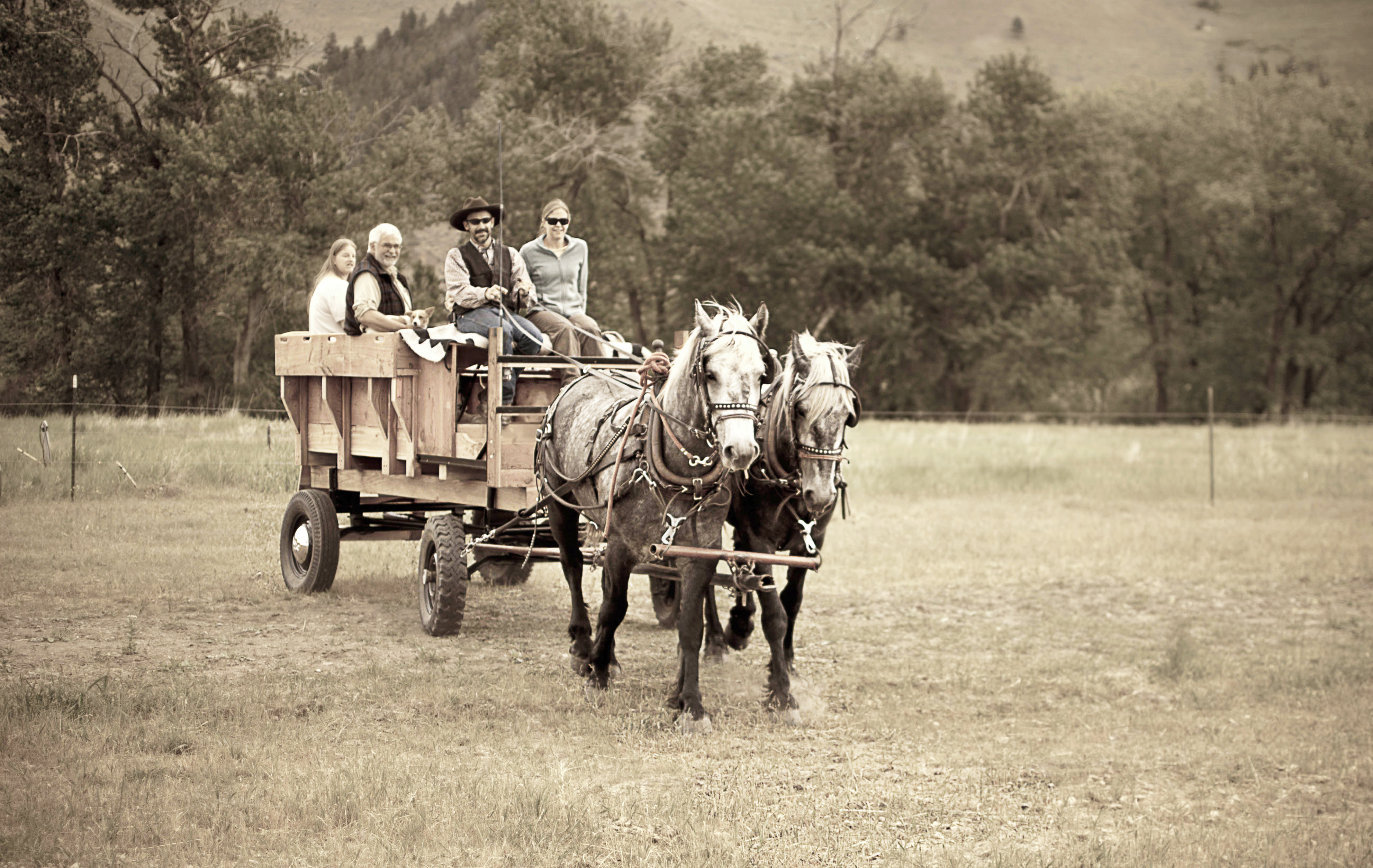
The great thing about having a reputation for eccentricity and total lack of self control when fun and adventure are involved is that it brings all kinds of new people to Dunrovin’s doorstep. This is how Wayne, Waylon, and Willie with their beautiful handmade wagon fell into our laps.

Wayne is absolutely typical of many people who are drawn to Montana. They live here because they love the place and the people – not because they can make a lot of money. The saying is that you come to Montana to make a life, not a living. In fact, living in Montana generally required financial sacrifices – economists call it the “scenery tax” and everyone along the economic scale understands it and pays it. So, when Wayne’s sweetheart – and she is a sweetie – got an offer for a great, secure job at the University of Montana, Wayne began to disassemble his life near Bozeman and relocate to our area.

For the last several decades, Wayne has cobbled together a living, and enjoyed a great life, from working during the summer months and holiday season as a wrangler and sleigh driver for the Lone Mountain Ranch in Big Sky, Montana, and heading north to Alaska during the hunting season to serve as a guide. At Lone Mountain, Wayne became a master teamster, and applied his natural gifts with animals and his teamster knowledge to train a beautiful pair of Morgan/Percheron/Friesian geldings named Waylon and Willie (naturally!). Unfortunately, he did not actually own the pair.

It was clear to us the moment that Wayne set foot on the property that he is a special person. His gentle, quiet way with his horses is inspirational and is the foundation for the superb performances he achieves with them. We hope  to find a way to include Wayne at Dunrovin and help him establish a thriving business with his magnificent team in our area.

Written by DunrovinSuzAnne · Categorized: About Dunrovin Ranch

Dec 11 2014

Ranch History

Dunrovin Ranch is the product of evolution rather than careful planning and purposeful development. Dunrovin’s owners, SuzAnne and Sterling Miller, were somewhat surprised to find themselves as hosts for guest ranch visitors from around the world. They are scientists: Sterling is a wildlife biologist and SuzAnne is a biometrician (mathematics as applied to biological problems). They had enjoyed long professional careers with state, federal, and international natural resources management agencies before returning to SuzAnne’s home state of Montana in 1997. Initially they continued with their scientific work. Sterling worked for the National Wildlife Federation and SuzAnne consulted with many state and federal agencies.

SuzAnne, however, began to spend more and more time playing outdoors and less and less time in her office. Somehow SuzAnne’s love for back country adventures, horses and dogs (all animals, really), Montana, and a desire to share those loves with friends and family lead her down the trail to incrementally creating Dunrovin Ranch with Sterling’s blessing and assistance.

IMG_5634

What’s in a Name?

Visitors to Dunrovin Ranch frequently assume that Dunrovin is SuzAnne’s family name of Scottish origin. It’s a reasonable assumption.The similar sounding Dunrobin Castle is one of Glasgow’s most famous and beautiful fairy-tale castles. Alas, her family roots do not lead to Dunrobin castle. Rather, the name “Dunrovin” comes to SuzAnne from her great grandmother’s love of Montana.

As a young woman in the 1880s, her great grandmother, Clara, and her husband, Harry, lived in a log cabin along Carpenter Creek near the mining town of Neihart in Montana’s Big Belt Mountains. There, she gave birth to SuzAnne’s grandmother, Gertrude. Circumstances, however, forced the family to leave Montana and return to the Midwest where, with the proceeds from his Montana mining adventures, Harry built a mansion on banks of the Mississippi River.

Harry was clearly a risk taker – something he and SuzAnne seem to share. Unfortunately, his risk taking got him into significant financial trouble (let’s hope this is where the ancestral comparison ends!) and he lost his fortune. Ashamed of his losses, Harry literally abandoned his now very large family and fled to the woods of Wisconsin (here the ancestral comparison definitely ends!). Left with seven children and a huge house, Clara did the only sensible thing: she piled the family into one bedroom and opened a boarding house. She remained there until the last child left home and she was free to follow her own muse –Montana.

Gertrude and two of her sisters had already been lured back to Montana by the time Clara was free to find her way back to the tiny settlement of cabins along Carpenter Creek. Upon arrival, she declared that she was “Dun Rovin’” – she never meant to leave Montana and she was back to stay. A “Dun Rovin” sign was fashioned from wood and nailed above the front door.

Chapter 2_ What's In a Name_ Photo 4

As a child, SuzAnne spent many wonderful summer days (and a few winter days) with her grandmother at Dun Rovin. Her heart is full with memories of long summer days hiking the hills, picking wild raspberries, fishing the streams, and sleeping on the screened-in porch during wild thunderstorms. Best of all, they searched the old mining town dumps for fancy colored glass bottles. Grandma and she gathered a collection of perfume and oil bottles that they kept in a beautiful wooden steamer chest with multiple compartments. That chest with it amber, sage, and azure colored bottles is still vivid in SuzAnne’s mind. Oh, to have it today!

Chapter 2_ What's In a Name_ Photo 3
Those Montana memories were always fresh in SuzAnne’s heart and mind as she moved about the world: Seattle for graduate school, Chile for three years with the Peace Corps, and Alaska for over twenty years of working with natural resource agencies. Montana remained her real home throughout those years. Once her aging parents required assistance and SuzAnne and Sterling could retire from their positions, they turned their family towards that Montana home. SuzAnne too was “dun rovin” and immediately gave the name Dunrovin to their little piece of heaven along the Bitterroot River.

Chapter 2_ What's In a Name_ Photo 7

Within a few months of her family’s return to Montana and SuzAnne tacking up her own “Dunrovin”  sign, SuzAnne received a book in the mail from a distant relative, which told the story of her great grandmother and the naming of the Dun Rovin cabin. In that book, for the first time, SuzAnne saw a picture of her great grandmother Clara with “her fancy gaited horse, Lady.” Clearly, this acorn fell close to the family tree: SuzAnne now has her own “fancy gaited horse,” Lady Lonza, named after Clara’s grandson (SuzAnne’s father), William Lonzo Goodman.

Several years ago, SuzAnne drove back to see if the old cabin was still standing. Her family had sold it when her grandmother died. She found the cabin and left her business card taped to the door, asking the owners if they would be interested in letting her rent the cabin some day. About a month later, she received a call from the wonderful Great Falls couple who owned the cabin. They invited her to come and stay as long as she liked. What a great response to a person (SuzAnne) who have clearly trespassed on their property! It gave SuzAnne yet another reason to be delighted to be back in her home state where people still trusted each other.


Written by DunrovinSuzAnne · Categorized: About Dunrovin Ranch

Nov 27 2014

Dashing Through the Snow

In a winter scene straight out of a Christmas song or card, a small group of whitetail does and fawns congregated in Dunrovin Ranch’s winter pasture to share in the horses’ hay. They calmly walked to the far east end of the pasture, stood at alert for a moment, then suddenly turned around and dashed through the snow, leaping over obstacles as they went. The Dunrovin herd did not share in their excitement and calmly stood to watch them. We happened to have a camera operator on duty who was able to follow the deer for a short distance and make a fun half minute video of their morning romp. While whitetail deer are a very common sight at Dunrovin, they are always fun to see.

Written by DunrovinSuzAnne · Categorized: About Dunrovin Ranch

Nov 21 2014

Ranch Environs

Dunrovin Ranch is located along the Bitterroot River in some of the most beautiful and interesting country in the world. Western Montana is known for its forested and snow capped mountains, its clear, cold creeks and white water rivers, its high mountain meadows, its wide, handsome valleys, and its abundant wildlife. It is also know for its outgoing people, its charming little communities, and its many wonderful cultural features that blend small town friendliness with big city sophistication and quality. It is truly the Last Best Place.

The Bitterroot Valley

The stunning Bitterroot Valley extends nearly 100 miles south from Missoula into Lost Trail Pass on the Montana – Idaho border. The entire Valley is lined with mountains on either side – to the west is the Bitterroot Range and the large Selway-Bitterroot Wilderness Area; to the east you will find the smaller Sapphire Mountains and the Anaconda-Pintler Wilderness Area. On the west side of the valley are numerous deeply-carved granite canyons, such as the scenic Blodgett Canyon and Bass Creek Canyon. Trapper Peak is the highest point in the “Bitterroots,” at more than 10,150 ft. in elevation and provides a dramatic punctuation to the southern end of this valley. Highway 93 is the major north-south highway running through the center of Bitterroot Valley, offering some of the America’s most scenic highway vistas.

Bitterroot Valley

The wide mostly flat valley bottom is known for its fertility and relatively moderate climate and supports a number of ranches and farms that work hard to feed local Montanans. Along the length of the valley, the Bitterroot River ripples and curves, offering blue ribbon fishing, as well as float trips in the summer months. The terrain of the Bitterroot Valley changes considerably between the northern and southern portions. The northern end is quite flat and open. It is considerably wider than the southern portion with beautiful panoramic views overlooking hay fields and towns, all with beautiful mountain backdrops. The southern end narrows and is barely five miles wide. The Bitterroot River splits into the East and West Forks and you have more trees and close-up views of mountains, rock formations and wildlife.

The first settled community in the valley sprung to life when St. Mary’s Mission was established in 1841 and followed shortly by Fort Owen—around 1850. This early establishment quickly evolved into what is now the vibrant community of Stevensville. Soon after, other early settlements began to spring up and down the valley located about a day’s horseback ride apart. These settlements have all evolved into friendly, little communities that are unique centers for outdoor recreation, festivals, and high quality living. From north to south and starting with our own community, you will find:

  • Lolo, home of Travelers’ Rest Montana State Park, the Lolo Square Dance Center, Lolo Hot Springs, and the best steak in all of Montana at Lolo Creek Steak House
  • Florence, location of one of our favorite Italian Restaurants, Caffé Firenze
  • Stevensville, Montana’s oldest European settlement celebrates its agricultural heritage each year with the Northwest Honey Fest
  • Victor, where they annually celebrate their namesake, Chief “Plenty of Horses” Victor
  • Corvallis, home of the Teller Wildlife Refuge
  • Hamilton, a bustling little city that boasts one of the nation’s leading research labs, the Rocky Mountain Laboratories
  • Darby, know for it logging history which they celebrate every year during Logger Days
  • Conner and Sula both serve as gateways to Lost Trail Pass, one of Montana’s favorite places for both downhill and cross county skiing, and Lost Trail Hot Springs.

The Bitterroot River

collage01

The Bitterroot River is a wide artery of free flowing, clear water, winding over 80 miles from the Bitterroot Mountains to its confluence with the Clark Fork River in Missoula.
Internationally known as a blue ribbon fly fishing river, the Bitterroot’s many riffles, deep pools, fallen trees, and seasonal hatches make it one of Montana’s most popular fly-fishing destinations. Anglers enjoy a long season wrangling cutthroat, brown, rainbow, and brook trout beginning in early March and extending through November. To cast your line a little further, check out our partner Grizzle Hackle who will happily take you on a guided float or wade trip. Be sure to visit Montana Fish, Wildlife, and Parks Field Guide for information on all the fish that can be found in the Bitterroot River.

fish collage

Dunrovin’s favorite term for the Bitterroot River is friendly. Except during the high spring run-off, the Bitterroot’s gentle flow and crystal clear water is perfect for long, lazy summer floats whether incanoe, drift boat, raft, or inner tube. The enticing, cool water is irresistible in the heat of the afternoon and picnicking on one of the numerous sandy beaches or gravel bars is the perfect reprieve.

Dunrovin Ranch has its own swimming pool, complete with sandy beach and shady trees—carved out by an old channel of the river. We call it “Dunflowin” to denote its still, spring waters – cool and deep. There is no other place to be on a hot summer day!

The excellent habitat of the Bitterroot River and its riparian corridor provides Dunrovin’s guests with ample opportunity to view wildlife. The Bitteroot Birding and Nature Trail guides visitors through some of the valley’s most vibrant bird habitat and nature viewing areas and the Montana Natural History Center offers tours lead by local naturalists.

Dunrovin offers guided canoe trips with plenty of time for swimming, wildlife viewing, and picnicking in some of Montana’s most scenic country.

The Lewis and Clark Expedition

The wild terrain and striking beauty of the Bitterroot Valley has held travelers in reverence since the days of Lewis and Clark. The Corps of Discovery entered the area in the fall of 1805 through the southern part of the valley, at Lost Trail Pass. From there, they traveled north toward present day Missoula to the confluence of Lolo creek and the Bitterroot River. At this juncture, which was named Traveler’s Rest, the Corps of Discovery turned westward once more, to cross over the Bitterroot Range through Lolo Pass—following Lolo Creek and the Nez Perce Trail. In July of 1806 the Corps of Discovery visited Traveler’s Rest again on their return journey eastward. At that time, the group split into two; with Lewis headed northeast and Clark south, for further discovery.

collage

At many places in “The Bitterroot,” visitors can read roadside signs that illustrate Lewis and Clark’s movement through the valley. Yet, most don’t suspect that Dunrovin Ranch has one of these markers on its property that actually provides incorrect information identifying the location of Travelers Rest, which is now a state park. Fortunately, this was a short-lived mistake and Traveler’s Rest State Park has been correctly identified 1.3 miles west of the ranch.

The Traveler’s Rest Preservation and Heritage Association has been a driving force in helping Traveler’s Rest State Park develop a museum and visitor’s site that tell the compelling story of the Corps of Discovery. Bill and Ramona Holt of the Holt Heritage Museum have been particularly supportive and instrumental in making Traveler’s Rest the center of Lolo and bringing the story of Lewis and Clark to visitors and residents alike.

Dunrovin Ranch owners, Sterling and SuzAnne Miller, have long been ardent fans of Lewis and Clark, marveling at their courage and leadership. The more they learned, the more impressed they were. It is nearly impossible not to be awed by their achievement. They lost only one person to sickness during their two year journey. They sought and obtained friendship and assistance from most of the American Indian tribes they encountered, with only one hostile encounter that ended in an Indian fatality. Their scientific findings and measurements were rigorous and invaluable in understanding the country through which they traveled, and their sense of geography coupled with their just and confident leadership of the corps made the expedition successful. One of the Miller’s favorite places for finding information about them is Discovering Lewis and Clark.

Dunrovin Ranch strives to emulate the characteristics so aptly demonstrated by the Corps of Discovery by celebrating courage to explore new territory with a sense of scientific and cultural curiosity and respect, fostering a connection with local residents for better understanding of place, demonstrating a focus on the safety of all involved, and approaching the natural world with a sense of awe.

Dunrovin Ranch – a Bird’s Eye View

Dunrovin Ranch utilizes private, leased, and permitted state land for its operation. The GoogleEarth photo below indicates the property lines, the osprey nest pole, and the fishing locations most used by ospreys nesting at Dunrovin: the Bitterroot River, the lake, and local fish ponds.

2014_Global Earth - DR Area of Use

The  view below shows the same area as seen from a low flying plane. If you look carefully, you will note the osprey nest and camera pole to the left of the red roof on Dunrovin’s barn and the ranch camera pole to the right and towards the river from the red roof.

Dunrovin Ranch from the air -Photo 1 cropped


Written by DunrovinSuzAnne · Categorized: About Dunrovin Ranch

  • « Previous Page
  • 1
  • …
  • 5
  • 6
  • 7
  • 8
  • 9
  • Next Page »
  • About
  • Activities
  • Contact/Payment
  • Webcam

© Copyright 2015 Privacy policy | Terms of Use | Brought to you by: Modern Entrepreneur